

People Know When You’re Creating or Selling
And they reward the creators every time.

Tigabu HaileDecember 16, 2025
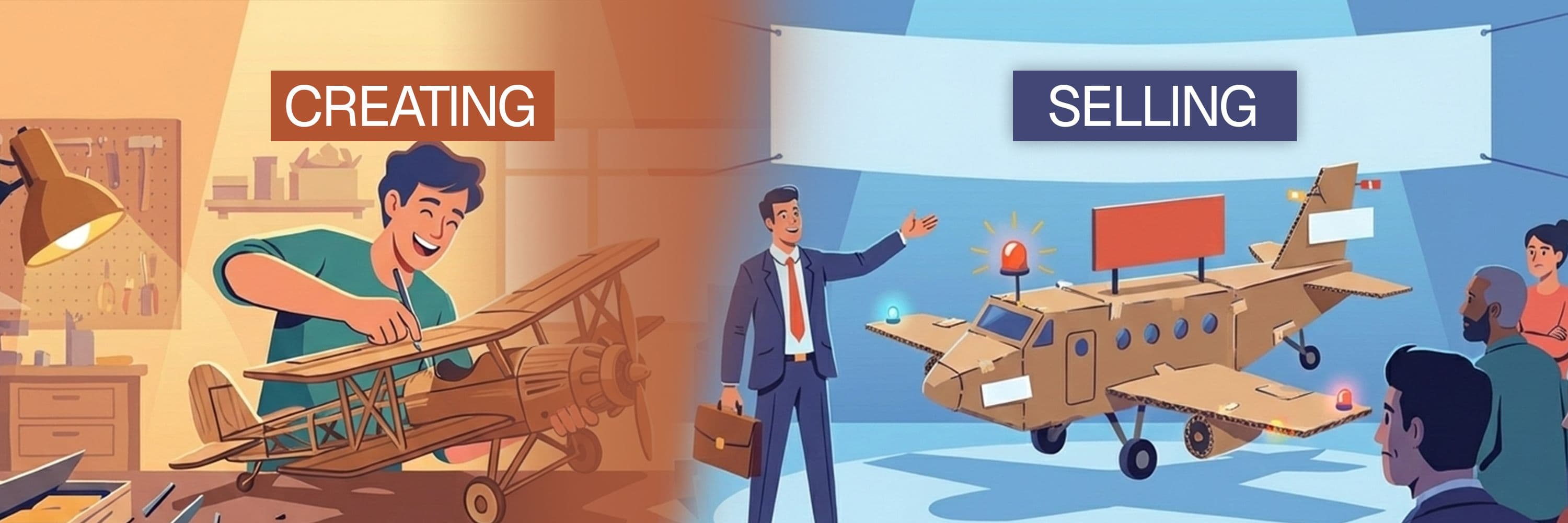
The Beauty of Work That Exists for Itself
There is a quiet truth found across every art form. A song doesn’t become beautiful because millions listen to it. A painting doesn’t become meaningful because a museum buys it. Art gains its value from the depth of its creation, not the height of its attention. Its beauty is already inside it; the audience arrives later. This principle applies just as much to founders, engineers, and builders as it does to painters and musicians. When you build because you love the craft, the purpose, the difficulty, and the improvement, the work comes alive. It has energy. It has honesty. It holds its center.
Rick Rubin, one of the most influential music producers of the past four decades, captures this mindset well when he says the audience comes last. Not because the audience doesn’t matter, but because chasing them too early kills the soul of the work. Creation becomes fragile the moment the creator looks over their shoulder.
When the Motive Corrupts the Work
Founders often fall into the same trap young artists fall into: creating with the outcome in mind instead of the craft. They want reach before originality, fame before substance, monetization before mastery. They start a network not because they enjoy people, but because they hope to turn it into money. They launch a podcast not because they care about conversations, but because they want a marketing channel. They build a platform not because they believe in the platform, but because they want to sell something.
People sense the difference immediately. A conversation meant to sell doesn’t feel like a conversation. A community built to extract doesn’t feel like a community. A platform designed to harvest attention rarely keeps attention. And a creator driven by outcomes burns out the moment the outcome is delayed. Difficulty exposes motive. If the motive is hollow, the work collapses.
Creation Has a Center, Or It Has an Expiration Date
Projects die when the creator isn’t rooted in love or curiosity for the work itself. They get tired, discouraged, or uninterested because the engine was never internal. There are only two kinds of creators in the world: those who create for what they get, and those who create for what they become. The first group fades quickly. The second group builds history.
Rick Rubin’s other warning is equally true: if you create to please others, your work will never be pure. The people who shape industries, the category creators, build from obsession and conviction, not tactics. Steve Jobs didn’t design products for market share; he designed them because he was obsessed with elegance. Jeff Bezos didn’t build Amazon for attention; he did it because he was consumed by customer experience. Elon Musk didn’t build rockets for applause; he built them out of a genuine belief about the future.
Depth outperforms cleverness. Sincerity outlasts strategy. Work with a center stays standing.
Originality Is Not Comfortable, But It’s Necessary
Being original is not peaceful. Doing something no one has done before comes with its own shortcomings. New things rarely feel polished. They rarely fit expectations. They often look strange, premature, or even insane. But that is why they stand out. People pay attention to what breaks pattern, not what imitates it. Newness attracts curiosity long before it attracts approval.
Imitating someone else shrinks your power twice, first when you betray your originality, and again when the world amplifies that betrayal. Over time, this destroys creators. They burn out, lose inspiration, and abandon the work because they were never building from their own center. Originality might feel uncomfortable, but imitation guarantees irrelevance.
Byproducts Are Not Targets
When you create for the sake of the creation, the rewards come naturally. Money becomes a byproduct. Network becomes a byproduct. Fame becomes a byproduct. Opportunities become a byproduct. The world is built by people who were deep in their craft long before the world validated it. They didn’t aim at recognition; recognition arrived because the work demanded it.
Creators who chase byproducts never get them in depth or for long. Their work lacks soul, so it never compounds. Their projects lack center, so they never last. Their identity lacks grounding, so they never ascend.
The World Is Built by Those Who Love the Work
In business, in art, in engineering, in leadership, the strategy that outlasts all others is simple: create because you must. Do it because the work deserves to exist. Do it because you become someone different through the process. Do it because sincerity is felt, not marketed. Everything else, the attention, the respect, the money, the opportunities, comes after.
People who chase outcomes exhaust themselves.
People who chase the work transform themselves.
And the world is built by the second group.