


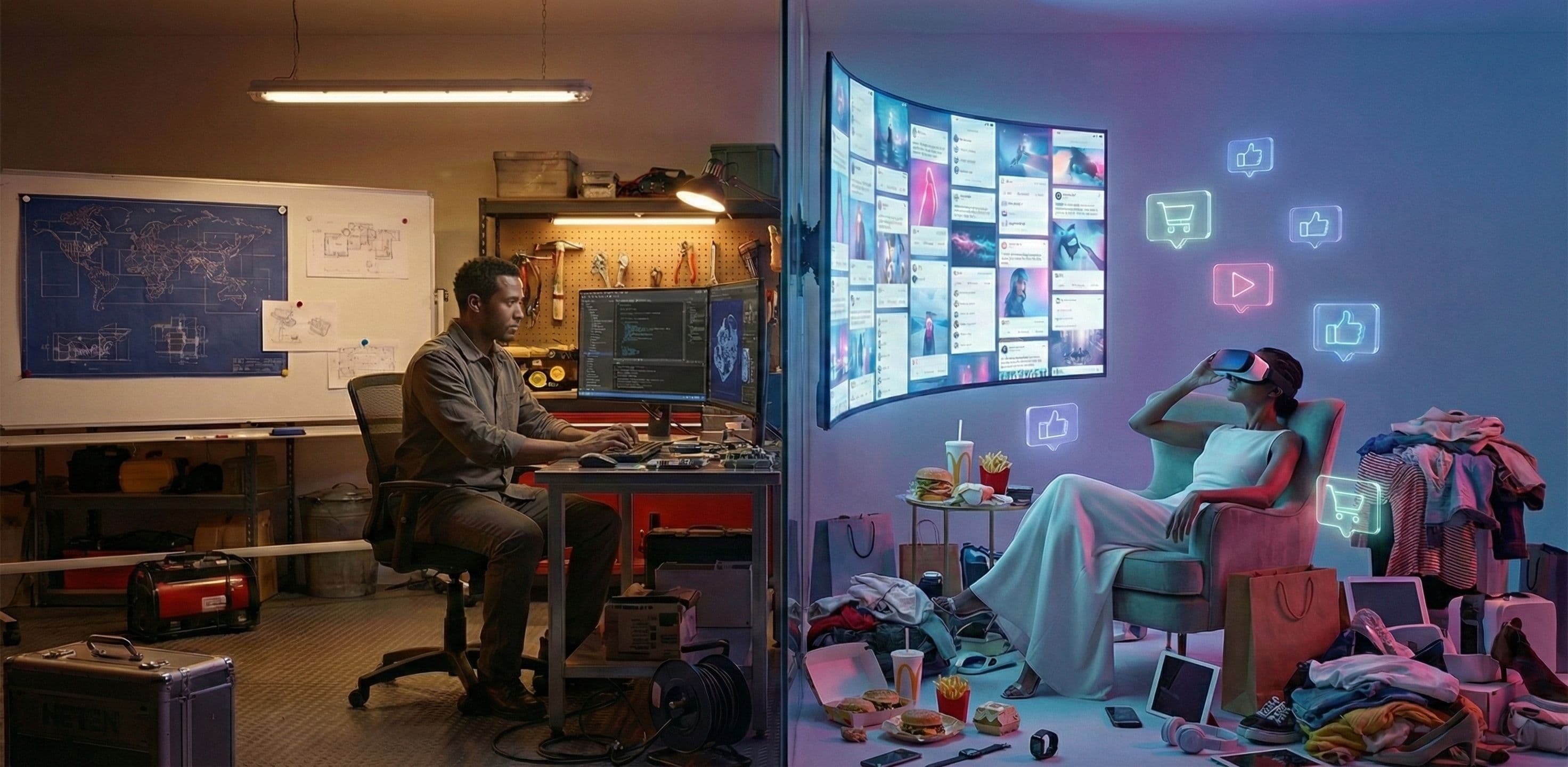
There are endless debates about why countries are poor. History, policy, geopolitics, corruption, conspiracy theories, regulation, all of them get airtime. Some of them matter. Many of them are convenient explanations. But if you want a definition that is simple enough to guide action, not argument, one distinction cuts through most of the noise.
A person is poor when their life is structured around consuming more than producing.
A country is poor when most of its capacity is oriented toward consumption rather than production.
It’s not a moral statement. It’s an economic one. And it scales frighteningly well, from the individual to the nation.
A Definition That Works at Every Level
Production means creating value that did not exist before. Skills. Goods. Services. Systems. Ideas that turn into something usable. Consumption means using what already exists.
At the national level, countries rise when they produce more than they consume, not just in volume, but in capability. When they build things, refine processes, create industries, and compound know-how. At the individual level, the same rule applies. People rise when their time, energy, and attention are invested in output rather than intake.
This framing doesn’t explain everything. But it explains enough to be dangerous.
The Modern World is Designed to Make Consumption Effortless
Consumption has never been easier. You don’t even need effort anymore. Content scrolls itself. Episodes queue themselves. Entertainment removes stopping points by design. You can spend hours absorbing without ever deciding to.
That is not an accident. Making consumption easier is good business. The easier something is to consume, the more of it people take. From the producer’s side, that’s innovation. From the consumer’s side, it’s a trap if left unchecked.
The problem isn’t that consumption exists. It’s that it wins by default.
Why consumption feels productive but isn’t
Consumption often disguises itself as progress. Reading about success feels close to building something. Watching other people create can feel like participation. Following global debates can feel like impact.
But awareness is not output.
Opinion is not leverage.
Engagement is not creation.
A person can spend years consuming information and still produce nothing that changes their own trajectory. That’s the quiet cost: not wasted time, but stolen potential.
Production is Uncomfortable for a Reason
Producing feels harder because it is. It exposes you. It creates visible failure. It forces judgment. Early output is clumsy. Nobody applauds. There is no instant feedback loop.
That discomfort is exactly why production works. It builds skill. It compounds judgment. It creates assets that survive mood and trend cycles.
Consumption is emotionally smooth. Production is structurally rewarding.
Your Personal Economy Works Like a National One
Nations don’t become wealthy because they talk about growth. They become wealthy because they build capability. Factories. Software. Logistics. Skills. Institutions that produce repeatedly.
People are no different. You don’t get stronger by understanding strength. You get stronger by lifting. You don’t get wealthy by understanding money. You get wealthy by producing value that others exchange for money.
If your daily life is consumption-heavy, your days will feel light, but your future will feel heavy.
If your daily life is production-heavy, your days may feel heavy, but your future gets lighter.
Conspiracy Theories and the Illusion of Powerlessness
One reason consumption dominates is psychological. Conspiracy narratives about shadow powers running everything can make individuals feel irrelevant. If “everything is controlled,” then why produce? Why try?
That belief is itself a consumption product. It absorbs attention and returns nothing. It explains failure without demanding effort.
History shows the opposite pattern. Systems are built by people who decide to act inside constraints, not wait for them to disappear. No one produces in a perfect environment. They produce anyway.
A Rule You Can Actually Use
If you want a simple filter for daily life, it’s this:
- Earn your consumption with production.
- Before you scroll, make something.
- Before you watch, build something.
- Before you react, produce something real.
Not because rest is wrong. Not because enjoyment is weakness. But because the world is already optimized to consume your life for you if you let it.
Why This Matters More Than Ever
Technology multiplied consumption. It didn’t automatically multiply production. That gap is where poverty, stagnation, and frustration grow, both personally and collectively.
The people who change their lives are rarely the most informed. They are the most productive. The countries that rise are not the most expressive. They are the most capable.
Produce more than you consume.
Individually, that’s how lives compound.
Collectively, that’s how nations rise.
Everything else is commentary.