


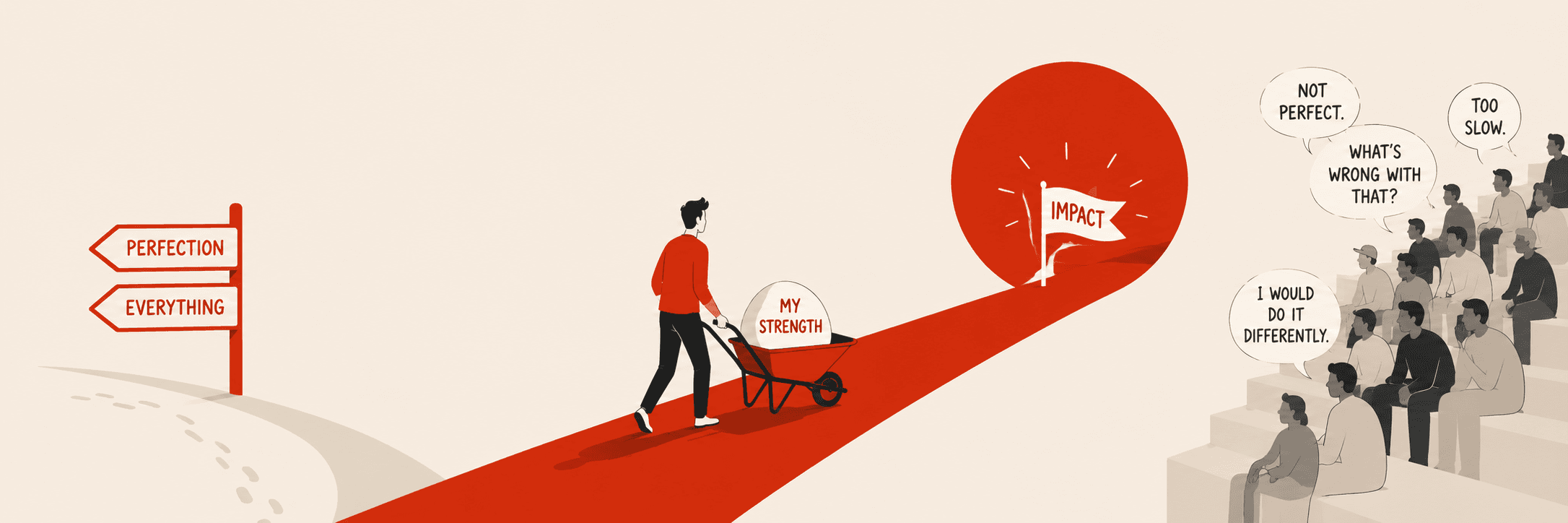
I have believed this for a long time, and I am more sure of it every year. You do not need to be perfect to succeed at anything. Not in a career, not in business, not in art, not in sport. Nowhere. And the part almost everyone gets wrong is what you do about your weak side. The instinct is to fix it, to sand it down until you look complete. I think that is mostly a waste of the one life you get.
The better path is narrow and a little uncomfortable. Find the thing you are genuinely great at and pour yourself into it, obsessively, past the point that feels reasonable. Then, for your weaknesses, do the minimum: keep them from becoming fatal, and otherwise leave them alone. And I will be honest, I am not even fully settled on that last part. Managing the weakness still costs time and energy that could have gone into the strength. So even the modest job of babysitting your flaws is worth questioning.
Because think about where fixing your weakness actually leads. You work and work on the thing you are bad at, and the best case is that you become average at it. You have spent your scarcest resources, time and attention and energy, to climb from bad to fine. Meanwhile the strength that could have become world-class sat waiting, underfed, while you were busy becoming unremarkable somewhere else.
The Data Is Not on the Side of the Fixers
This is not just a feeling. It is one of the most studied questions in the working world, and the answer is lopsided.
Gallup has spent decades on it, across an enormous base of people. In one study spanning 1.2 million employees in tens of thousands of business units across 45 countries, teams that were developed around their strengths improved on sales, profit, customer engagement, turnover, and safety, compared with teams that got the usual treatment. Other Gallup work found that people who get to do what they do best have a much higher probability of being productive and of holding customer loyalty. The pattern holds wherever they look. Build on what is already strong and the returns compound. Grind on what is weak and you mostly buy yourself mediocrity.
Here is the part that should stop you, though, because it is about you and not about companies. When Gallup asked people around the world a simple question, whether they thought they would improve more by focusing on their strengths or their weaknesses, most people chose weaknesses. Most people are wrong about the very thing that would help them most. That instinct, the pull toward patching the flaw, is nearly universal, and it is nearly universally mistaken. So if you feel it in yourself, you are not broken. You are just human, and the human default here happens to be the losing one.
Why the Flaw Feels So Loud
The reason we chase perfection is not really strategy. It is that we want to look complete. We want to stand in front of other people with nothing they can point at.
You see this most clearly in how we handle feedback. If you have ever put work into the world, you know the shape of it. A thousand people respond warmly, and two complain, and where does your mind go for the rest of the day. To the two. You reread them. You argue with them in your head. You let two strangers rent the space that a thousand supporters paid for.
I have done exactly this, and afterward I could only ask myself how foolish I was being. A thousand people were glad the thing existed and I was grieving over two who were not. That is not a bad ratio. That is a wonderful ratio. Even if the numbers were harsher, a thousand cheering and a few hundred complaining, it would still be a life most people never get. What matters is the people who are with you. You count those. The ones who are not with you were never going to be, and they are not the scoreboard.
And it helps to notice where most of the loud criticism comes from. It tends to come from people who have not done the thing, do not do the thing, and will never do the thing. This is not a new observation. More than a century ago, Theodore Roosevelt stood at the Sorbonne and said it as plainly as it has ever been said. It is not the critic who counts, he told the room, not the one who points out how the strong stumble or where the doer could have done better. The credit belongs to the person actually in the arena, whose face is marred by dust and sweat and blood.
That passage is famous. The lines right after it are not, and they cut even closer to what I am talking about. Roosevelt warned against the person who sits in cold comfort and criticizes work he never attempts himself. The point is not that criticism never matters. Some of it does. The point is that the people doing the work will always look more flawed than the people doing nothing, because action exposes weaknesses that inaction keeps hidden.
A piece of work can carry a hundred flaws and still matter, because it exists, because it has a living, interesting side that people pay for and enjoy and carry with them. They buy it, they love the part they love, and they move on. The flaw you would have died to fix, most of them never even noticed.
The Greatest People Are Deeply Uneven
Look closely at anyone who has done something remarkable and you find the same thing. They are not complete. They are spiked. Enormous in one direction and quite ordinary, sometimes worse than ordinary, in several others.
Someone is a genius at their art and a wreck at their health. Someone builds a great company or leads a revolution and is a stranger at home. Someone is a wonderful presence at home and mediocre at their job. The completeness we imagine behind great achievement is almost never there. What is there is a decision, made consciously or not, about which weaknesses to accept and which strength to take all the way. That is the actual choice. Not whether to be flawed, but which flaws you can live with and which excellence you will chase.
The founders who understand this do not hide the gap. They name it and then they hire it. Richard Branson built one of the largest groups of companies on earth while openly dyslexic, and he could not, for years, tell the difference between net profit and gross. He sat in board meetings unclear on terms a junior accountant would know. His answer was not to spend years forcing himself to become a finance person. His answer was to stay obsessed with building things people actually want, and to bring in someone who understood the numbers. He has said plainly that one of the smartest things a leader can do is hire people who are strong exactly where the leader is weak. Sara Blakely, who built Spanx from nothing, put it to him even more sharply. The smartest thing she did early on, she said, was to hire her weaknesses.
This is the move. If you are an artist and you do not care about money, do not spend your years pretending to become a businessperson. Go deeper into the art and find a great manager. If you are a builder who is weak at finance or marketing, do not grind yourself into a passable marketer. Hire the strong one and put your hours where you are dangerous. You are the one thing in your profession. Everything around that, you can staff, buy, or borrow.
Own It Out Loud
I want to be fair about the one real limit, because it matters. Manage does not mean ignore. A weakness left completely unattended can still sink you. The founder who is brilliant at product and so careless with cash that the company runs out of money did not succeed despite his weakness. His weakness ended the story. So the job is real, even if it is small. Keep the flaw from becoming fatal. That is the line. Below that line, you are free.
And within that freedom, the healthiest thing you can do is stop performing wholeness. Accept, out loud, that you are bad at many things. Not quietly, not as a confession you hope no one hears, but plainly. Yes, I am terrible at that, and I am at peace with it. There is a strange, real power in saying it, because the whole exhausting project of looking perfect ends the moment you stop pretending to be. What is left is simpler and stronger. You are great at a specific thing, you have decided not to care about the rest, and you have arranged your life so the rest is covered.
That is not a smaller life than the perfect one you were reaching for. It is the only version that was ever actually available. Perfection was never on the menu. The choice was always between a person spread thin across everything and a person concentrated, unafraid, and honest about the trade.
Be great at the thing that is yours. Manage what could kill you. And let everyone who never entered the arena keep score from the seats. Their comfort was always the tell.