


One of the strangest things about the world is how often intelligent people make decisions that look completely irrational in hindsight. We have more information than any generation before us: economists, engineers, intelligence agencies, consultants, historians, simulations, artificial intelligence and almost unlimited access to knowledge. Yet governments start disastrous wars, companies spend billions on failed strategies, investors chase obvious bubbles, and institutions keep pursuing decisions long after reality has contradicted them. It is easy to ask how they could possibly have been this stupid.
I think that is the wrong question. The more useful one is what makes bad decisions possible in environments full of intelligent people and information.
Information Is Not the Problem
The Bay of Pigs is a good place to start. Kennedy's administration did not impulsively decide to invade Cuba. There was intelligence, military planning, extensive discussion and senior-level review. The operation collapsed anyway, and the later investigation found serious failures in planning, coordination and oversight. What is interesting is that information and disagreement were present. The system simply failed to make the information that challenged the plan powerful enough to change the decision.
We imagine decision-making as information, analysis, decision, action. Real decisions run closer to information, incentives, interpretation, politics, decision and commitment. Information enters a system already shaped by hierarchy, reputation, fear, ambition, identity and previous commitments. People do not only ask whether something is true. They also ask, often without noticing, what happens to them if they say it is true.
Power Distorts the Information That Reaches It
The more powerful the decision maker becomes, the harder it gets to receive unfiltered information. A powerful person can get almost anyone to tell them what they think. Getting people to say what they actually think is a different matter.
If disagreeing with the leader carries a cost, people begin editing reality before it reaches the person who most needs to understand it. Over time an organization can become excellent at producing information and poor at telling the truth. This is why some of the world's worst decisions come from highly intelligent people. The problem is rarely the intelligence. It is the environment surrounding it, because a leader can only decide on the basis of the reality that reaches them.
Sometimes Nobody Actually Agrees
This produces a stranger phenomenon: groups making decisions nobody privately supports. One person doubts the plan but assumes everyone else knows something they do not. Another does not want to be difficult. A third assumes that if leadership has come this far, the concerns must already have been handled. The leader sees silence and reads it as consensus. Everyone leaves the room believing there was agreement.
No one had to lie. The system manufactured agreement because disagreement was expensive. And this is not limited to governments. It happens anywhere authority, reputation or social pressure makes honest disagreement costly.
Uncertainty Becomes Certainty When a Decision Needs a Story
The Gulf of Tonkin episode in 1964 shows another mechanism. Uncertainty about what had actually happened was present inside the American administration. Doubts about the second reported attack surfaced almost immediately, and later internal assessments described the evidence for it as extremely weak. The administration moved quickly toward one interpretation and one response anyway, and the resulting resolution became the legal basis for a major escalation of the Vietnam War.
The lesson is not that someone got the facts wrong. It is that uncertainty becomes dangerous when a decision requires a clear story. The situation offers ambiguity; the decision demands meaning. Once a narrative is selected, evidence that supports it registers as information while evidence that complicates it registers as noise. This happens in governments, companies and ordinary teams every day.
The Decision Starts Defending Itself
A company enters a new market. The research is encouraging, the consultants are optimistic, the team is excited, and the board approves the investment. Six months later the signals are bad. Instead of asking whether the original thesis was wrong, the organization asks how to improve execution. A year later the problem has become temporary headwinds. Eventually, abandoning the strategy would mean admitting that money, careers and reputation were built around a mistake.
The question quietly changes from whether this is working to how we make this work. Information is no longer being used to evaluate the decision. It is being used to defend it. And the sunk costs holding it in place are rarely just financial. They are reputation, political capital, careers, relationships and identity. The larger the commitment, the more expensive it feels to admit the original decision was wrong.
Intelligence Builds Better Defenses
We overestimate what data can do. Data does not interpret itself. Ten facts can support several conclusions depending on which ones we emphasize and what assumptions we carry into them. Humans are storytelling machines, and once we have a coherent explanation, information that reinforces it feels convincing while information that threatens it feels questionable.
This is why intelligence does not solve the problem. It helps you solve a problem; it does not help you question whether you are solving the right one. If anything, intelligence makes rationalization more sophisticated. A smart person with a preferred conclusion can usually build a better case for it than anyone arguing against them.
Our Situation Is Different
This is where Bent Flyvbjerg's work on reference-class forecasting becomes important. We naturally believe our situation is special: our team is better, our technology is different, our market is changing, and our leaders are unusually capable. Occasionally that is even true. But almost every failed project, strategy, investment and military operation also had a reason it was supposed to be different.
Flyvbjerg and his collaborators built a database of more than 16,000 projects across 20-plus fields and 136 countries. Only about 8.5 percent hit their cost and time targets, and roughly 0.5 percent hit cost, time and benefit targets together. The exact figures vary by project type, but the pattern holds with unusual consistency: from inside a particular project, humans systematically underestimate complexity, cost and time.
The outside view asks a much less flattering question. What happened to the other situations that looked like this one? That question reaches far beyond projects. We are remarkably good at constructing detailed stories about why our future will be different, and remarkably bad at accepting what the base rate says about stories like ours.
NEOM Is Not Really About NEOM
NEOM and The Line are interesting for the same reason. The original vision was extraordinary in scale, and parts of the program have since been substantially rethought as Saudi Arabia's sovereign wealth fund shifts toward capital discipline, profitability and greater private-sector participation. The Line has been significantly scaled back, while other elements of NEOM remain active.
The interesting question is not why someone dreamed big. It is how a vision accumulates enormous financial, political and institutional momentum while its assumptions remain insufficiently challenged. Once ambition attaches itself to national prestige, leadership identity and massive institutional commitment, challenging the underlying assumptions only becomes more difficult.
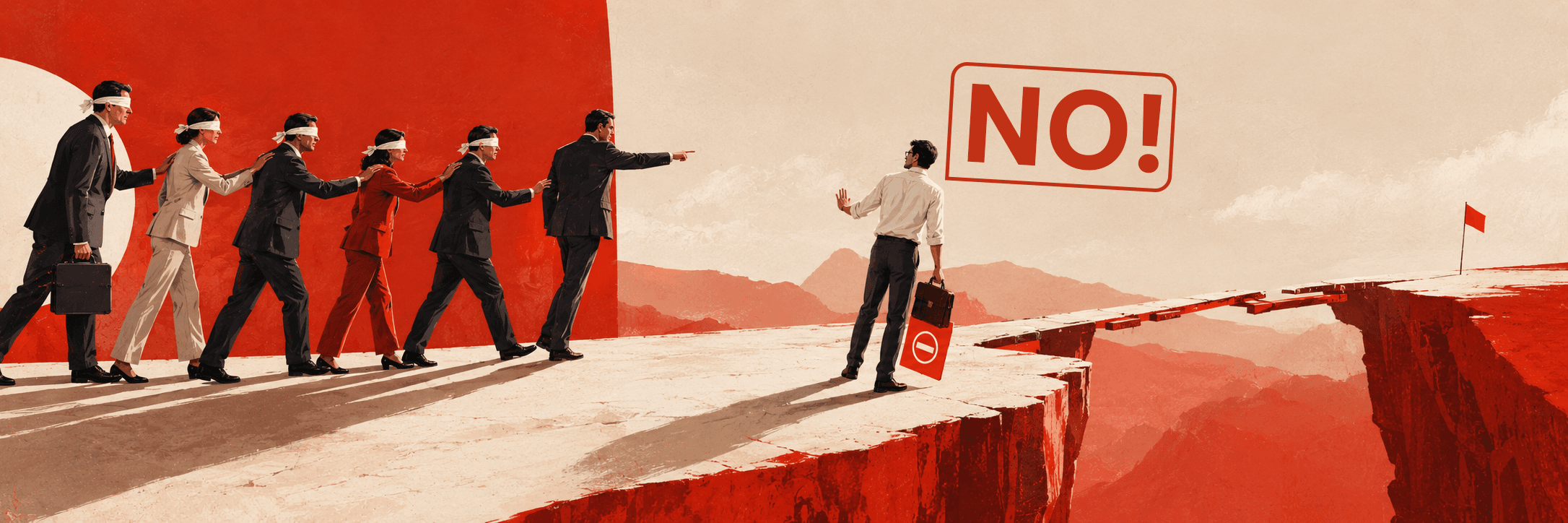
The newer strategy is revealing for another reason. The fund now explicitly emphasizes private-sector participation and co-investment, moving from large-scale capital deployment toward value realization and financial sustainability. Private capital does not automatically make a project better, but investors who can refuse to commit, or walk away, introduce a discipline an internal decision maker may never face. That is the principle underneath the whole essay, and it reaches well past Saudi Arabia. Someone who can say no changes the quality of the decision.
We Judge Others With Half the Information
There is another reason we misunderstand bad decisions. We see the decision but not the decision environment.
We watch someone stay in a job that seems terrible, invest in a business that looks doomed, reject an opportunity that seems obvious, or remain in a situation we would have left immediately. Our reaction is often to ask why anyone would do that. But we rarely see the information, constraints, incentives and alternatives the other person was actually working with. From inside their situation, the choice may be answering a question we cannot even see.
None of this means everyone is secretly rational. People are biased, emotional and sometimes genuinely make terrible choices. It means that calling a decision stupid is usually easier than understanding the objective it was optimizing. Someone may be optimizing for security over growth, for loyalty over money, or for the avoidance of a risk we do not know exists. Their decision can look irrational against our objective and make complete sense against theirs. The same is true of governments and companies. That should make us slower to narrate other people's decisions and more interested in the mechanics of our own, where we actually hold the information and the authority to act.
The Same Fear, Pointed the Other Way
Everything so far is about a decision that cannot be stopped. There is a mirror failure: refusing to make a decision at all.
It is not exactly the same mechanism, but it often shares the same fear of visible error. A bad decision creates an owner. Indecision hides the owner. When acting creates a visible possibility of failure, and doing nothing keeps the risk out of view, people experience inaction as the safer choice.
It rarely is. A company spends two years debating whether to enter a market while competitors build distribution. A founder waits for perfect information while the opportunity closes. A government postpones a difficult reform until the eventual cost is several times larger. In none of these cases did anyone decide to lose; they decided not to decide, and the opportunity disappeared anyway.
The reason this is so easy to miss is that the cost of a bad decision is visible and the cost of indecision is not. A bad decision leaves an artifact: a failed launch, a number, a contract, a date. Indecision usually leaves nothing behind but the deal that expired, the hire that was never made, the market someone else captured. There is no post-mortem for the thing that never happened, which makes indecision unusually difficult to learn from and unusually easy to underrate.
What We Are Actually Missing
If information is not the missing ingredient, what is?
We are missing systems that reward truth over agreement. We are missing mechanisms that force historical evidence into important decisions. We are missing people with both the permission and the responsibility to challenge the dominant narrative. We are missing predefined conditions for changing course. We are missing environments where changing your mind is treated as intelligence rather than weakness.
The quality of a decision depends on more than the intelligence of the decision maker. It depends on how much reality the environment allows that person to see, and on whether the environment allows a choice to be made before the opportunity changes.
Design the Decision, Not the Pile of Information
The answer is not to collect infinitely more information. At some point another spreadsheet, consultant or 200-page report adds almost nothing. The answer is to design the decision itself.
Separate facts, assumptions, forecasts and hopes before discussing the conclusion. Force the outside view into the room by asking what happened the last twenty times someone tried something similar. Make disagreement cheap: the leader should sometimes speak last, and someone should have explicit responsibility to attack the proposal rather than approve it. Run a pre-mortem by assuming the decision has already failed three years from now and working backward through why.
Then define two things in advance: what would make you stop, and what would make you go. This is where rigor quietly turns into avoidance. One more piece of analysis can always be justified, one more consultant hired, one more scenario modeled, until diligence has become a respectable way of refusing to choose. A decision without a deadline is often avoidance with better vocabulary. Once more analysis stops changing the shape of the choice, it has stopped being analysis.
Know What Kind of Decision You Are Making
Not every decision deserves the same amount of thought. When a choice is cheap to reverse, speed is the discipline, and treating it as momentous wastes time you do not have. When a choice is expensive or irreversible, scrutiny is the discipline. And when waiting itself changes the economics, when an option decays while you deliberate, delay stops being neutral and becomes a decision that has to be justified like any other.
The objective was never certainty. It is knowing which uncertainty is worth acting through.
Design for Reality
So when I see a government make an absurd decision, a company burn hundreds of millions, or an organization pursue something for years after the evidence has turned, I no longer find the word stupid useful. I want to know who could have said no, what information existed, what was ignored, what incentives shaped the conversation, when uncertainty became certainty, what made changing course expensive, and what made choosing feel more dangerous than waiting.
Caution asks what happens if we are wrong. Judgment asks that, and the question caution tends to miss: what it will cost us if we wait.
The world will keep producing decisions that look insane in hindsight. We will make some of them ourselves, and we will misjudge other people's because we cannot see the environment they were made in. The goal is not to eliminate bad decisions, which is impossible. It is to build environments where reality can defeat a bad idea early, where a good idea can move before the opportunity disappears, where people can change their minds without losing their standing, and where someone can say this does not make sense while there is still time to do something about it.