


Succession is one of the most misunderstood ideas in leadership.
We talk about it as if greatness should be transferable, as if an exceptional leader’s final test is whether they can manufacture another exceptional leader in their own image. When that doesn’t happen, the verdict is harsh: failure, ego, insecurity, unfinished work.
History tells a different story.
The rare leaders who truly change industries, organizations, or eras are not products of training pipelines. They are anomalies. And anomalies do not replicate on demand.
What does replicate is something else: systems, standards, habits, decision rules. That’s the part people undervalue because it doesn’t look heroic.
The Category Error at the Heart of Succession
Peter Drucker (Peter Drucker was the most influential management thinker of the 20th century, widely regarded as the father of modern management) warned repeatedly that management is teachable, leadership far less so. Management is a discipline. Leadership, at the highest level, is a convergence of judgment, timing, taste, psychology, and circumstance.
You can train operators. You can develop executives. You can produce competent stewards. What you cannot reliably produce is a once-in-a-generation builder.
This is where most succession debates go wrong. They confuse continuity with replication. They assume that because something extraordinary existed once, it should be reproducible by design, like a factory output.
It never works that way. Greatness shows up through rare combinations, and those combinations don’t respect your organizational chart.
What History Actually Shows
Look closely at biographies of exceptional builders and the pattern is remarkably consistent.
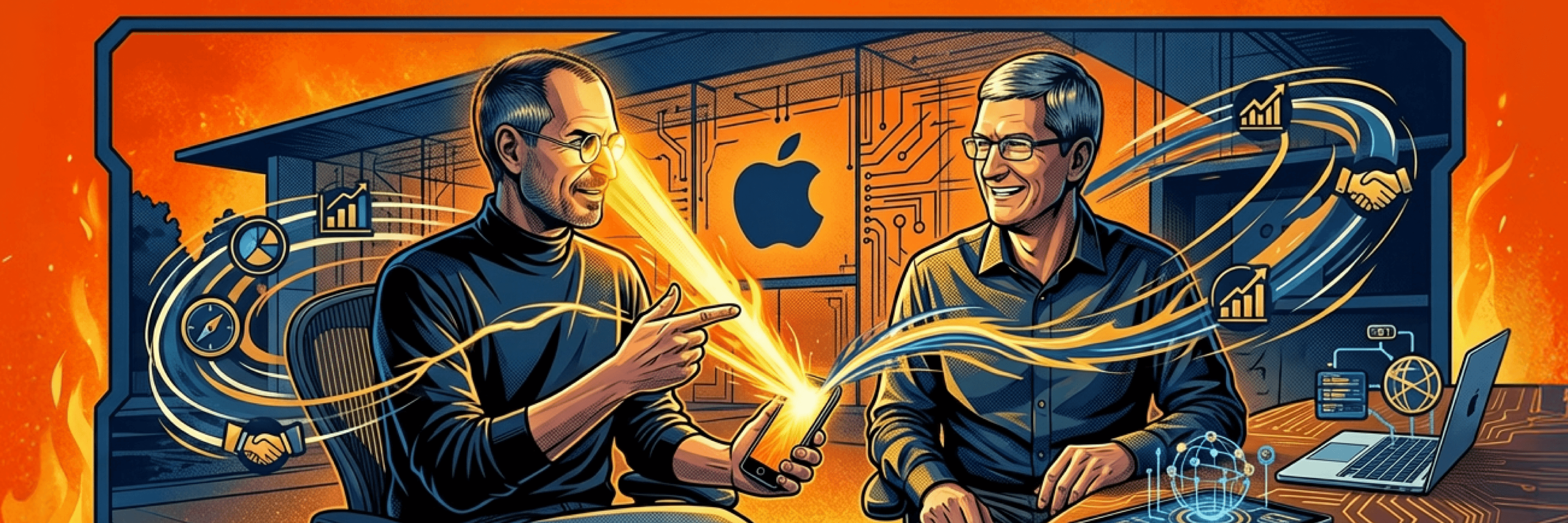
Steve Jobs did not surround himself with replicas. He built teams that complemented him: operators, engineers, designers, executors. His taste, which was the real source of his edge, was translated into systems, standards, constraints, and a culture that could enforce quality without him supervising every decision.
Apple did not need another Jobs. It needed someone capable of maintaining momentum, protecting coherence, and scaling execution while the effects of earlier decisions continued to compound.
That is not failed succession. That is succession done correctly.
It also explains something people find uncomfortable: a successor can be excellent at running what exists, while still being fundamentally different from the person who created it. That difference is not a betrayal. It’s the point.
Builders Create Slopes. Maintainers Keep Them Standing.
Jim Collins, in Good to Great, observed that enduring organizations are rarely led by charismatic replicas of their founders. They are led by disciplined stewards who protect the core while allowing gradual evolution.
Collins describes this as the difference between time tellers and clock builders. Time tellers produce brilliance that depends on them. Clock builders create systems that outlive them.
Exceptional leaders often do both for a period. Their successors usually do only one, and that’s enough, if the system is strong.
The real question is not whether the successor is dazzling. It’s whether the organization can keep compounding without needing a hero every quarter.
The Generational Trap
This misunderstanding doesn’t only show up in companies. It shows up in families, dynasties, and social expectations.
Second and third generations are often judged unfairly, not by what they build, but by whether they resemble the founder-father or the legendary grandfather. They inherit a myth, not a job description. They’re expected to be both the original builder and the current operator, to have the same hunger, the same instincts, the same taste, the same edge.
That expectation creates a quiet kind of damage.
Some heirs overcompensate, trying to perform greatness instead of earning credibility through stewardship. Others reject the legacy entirely, because they can’t win a comparison that was rigged from the start. A few do the healthiest thing, they treat inheritance as responsibility, not identity, and focus on preserving standards, improving systems, and building their own edge over time.
The generational version of succession teaches the same lesson as the organizational one: you can inherit infrastructure, but you cannot inherit a force of nature.
The Maintainer Misunderstanding
“Maintainer” is often used as an insult. It shouldn’t be.
Most organizations don’t collapse because they lack vision. They collapse because they cannot maintain standards once the founder’s intensity is no longer present. A company can survive without inspiration for a while. It cannot survive long without discipline.
Ben Horowitz (Is the co-founder of Andreessen Horowitz and the author of The Hard Thing About Hard Things, a book on leadership under pressure.) notes that wartime leaders and peacetime leaders are often different people. Wartime leaders create and fight. Peacetime leaders stabilize and scale. Expecting one person, or one generation, to embody all phases equally is unrealistic.
Succession is not about replacing fire with fire. It’s about converting fire into infrastructure.
Why Exceptional Leaders Don’t Train Replacements
Exceptional leaders distort their environments.
Their speed, conviction, and asymmetry pull organizations into orbits that normal people cannot sustain. They solve problems intuitively, not procedurally. That intuition cannot be handed over in a memo or taught in a leadership workshop.
This is why so many great creators struggle with traditional mentorship. They don’t think in steps. They shape outcomes. Their value is not transferable as instruction, only as architecture.
When people criticize them for not “developing a successor like themselves,” they’re asking a painter to produce another painter by writing a manual. The request misunderstands the craft.
The Real Obligation of a Great Leader
If cloning is impossible, what is the responsibility? Three things, consistently supported by leadership research and biography:
- Translate instinct into systems.
- Reduce dependence on personal presence.
- Protect standards, not mythology.
Culture should not be “what the founder would have done.” It should be what the organization does when the founder is not in the room.
A leader’s highest form of succession is not a replacement. It’s a set of constraints that keeps the organization from becoming sloppy, even when no one is watching.
The Illusion of Credit
Succession debates are also distorted by timing.
Outcomes lag decisions. Strategies, talent bets, and cultural norms often take years to materialize. A successor may appear brilliant while harvesting what was planted long before, or incompetent while paying the bill for decay they did not cause.
That’s why some leaders look like geniuses early and disappoint later, and others look unimpressive early and stabilize the entire system quietly. Leadership is not a snapshot. It is a long exposure.
What This Means for Founders
Succession is not a retirement problem. It is a design problem.
Ask early:
- Can this organization function without me for six months?
- Do decisions improve or degrade when I’m absent?
- Is culture explicit enough to survive personality loss?
- Have I turned taste into systems, or am I the system?
If everything depends on you, you didn’t build a company. You built a dependency. The goal is not to make yourself permanent. The goal is to make the standard permanent.
A Better Standard
The wrong question is: “Did they create someone as great as themselves?”
The right question is: “Did they leave behind something that could survive them without collapsing into mediocrity or chaos?”
By that standard, greatness looks different. Quieter. Less romantic. More structural.
And if you get it right, the organization won’t need a legend to keep moving. It will keep moving because the work, the expectations, and the discipline are now bigger than any one personality.