

The Best Country in the World, And the Lie Every Nation Tells Itself
The pride is real. The evidence is real. The blindness is more real.

Tigabu HaileJune 18, 2026
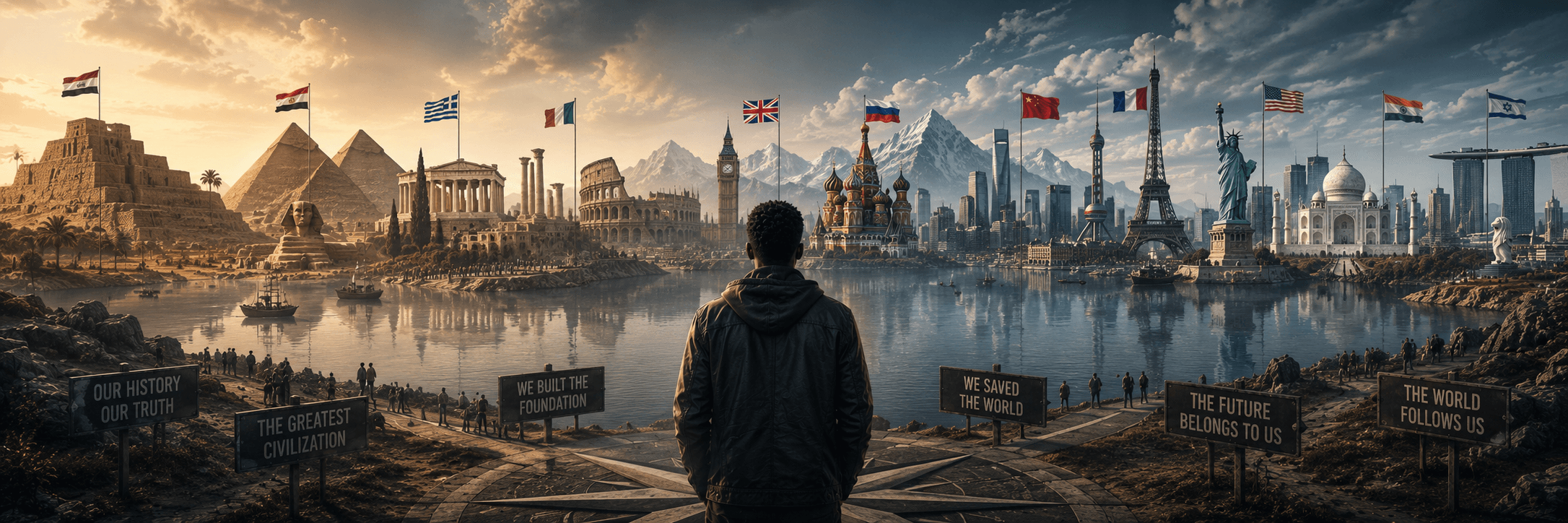
Here is something famous, obvious, and almost entirely overlooked: every country on earth thinks it is the best in the world.
Not "pretty good." Not "among the great ones." The best. The most important. The most historically significant. The most culturally refined. The most resilient. The one the rest of the world should be paying closer attention to.
I don't mean this as criticism. I mean it as an observation. Sit with a proud citizen from any country long enough, and they will build you a case so airtight, so emotionally compelling, so stacked with evidence, that by the time they're done, you'll half-believe them. Then fly to the next country, and listen to the exact same certainty, built on entirely different evidence, pointing to an entirely different conclusion.
I've done this. Not as an academic exercise, but as someone who was raised inside one of those stories and spent years assuming it was uniquely true.
Let me show you what I mean.
The Builders of Civilization
Start in Iraq, and you'll hear: We are where it all began. Mesopotamia. The Tigris and Euphrates. We invented farming. We built the first cities. We wrote the first laws, Hammurabi's Code, while the rest of the world was still figuring out fire. Every civilization that came after us is a footnote to what we started.
Fly to Egypt, and the answer is immediate: We built the pyramids. Not metaphorical pyramids, literal, physical monuments so impossibly precise that people still cannot fully explain how we did it. We were among the greatest civilizations the world has ever known. The Nile fed us, and we fed the intellectual history of the planet.
Cross the Mediterranean to Greece, and the tone shifts from monuments to mind: We gave the world philosophy, democracy, debate, medicine, mathematics, theater, the Olympic Games. Every serious thought the Western world has ever had started with us. Socrates. Plato. Aristotle. You're welcome.
Then Italy steps in, almost offended: Everyone is simply borrowing from us. We were Rome, we laid the roads, raised the aqueducts, and wrote the law the West still lives by. When the continent went dark, we lit the Renaissance. You eat our food. You copy our style. You make pilgrimages to our ruins. We are the aesthetic homeland of mankind.
Four countries. Four origin stories. Each one is genuinely documented. Each one positioning itself as the trunk of the tree, and everyone else as branches.
The Empires That Ran the World
Britain will tell you, with the kind of composure that comes from centuries of practice: We governed more than a quarter of the earth's surface. The sun literally did not set on us. We built the modern financial system, the common law tradition, and the English language that you, right now, are using to read this. We didn't just participate in history. We organized it.
Russia, with a different energy entirely, will push back: The West writes the histories, but we are the ones who actually saved it. We broke Napoleon. We broke Hitler. We sacrificed more lives in a single war than most nations have lost in their entire existence. We hold the largest landmass on earth, the deepest literature ever written, and we remain the one civilization the West has never been able to absorb or control.
China's response is patient, almost amused: We are the oldest continuous civilization on the planet. We invented paper, printing, gunpowder, and the compass, the four things your modern world was built on. We constructed the Great Wall, the largest man-made structure in history. And now, today, we are the manufacturing engine of the global economy. Give us another decade, and we'll be running the rest of it too.
Three former or current empires. Three completely different definitions of greatness. Three versions of "we ran the show" that cannot all be simultaneously true, and yet none of them is lying.
The Moral Authorities
France speaks with a certainty that borders on theology: We are the pinnacle of human civilization. We gave the world the Rights of Man; our Revolution taught humanity the words liberty, equality, fraternity. For three centuries, French was the only acceptable language of global diplomacy. We do not merely produce food, wine, and fashion, we set the standard of taste itself. The world eats, dresses, and thinks by our example.
The United States, characteristically, is louder about it: We are the engine of modern freedom. Democracy, innovation, the Marshall Plan that rebuilt Europe after we helped save it. Almost every transformative invention of the last two hundred years, the airplane, the internet, the smartphone, came from us. We are the destination for the world's dreamers, builders, and rebels. America isn't just a country; it's the idea that the rest of the world measures itself against.
India's case is quieter but no less sweeping: We are one of the oldest and most layered civilizations in existence. We are the birthplace of Hinduism, Buddhism, Jainism, and Sikhism, the spiritual source code for a significant portion of humanity. Today, our people run critical infrastructure across every Western economy, from emergency rooms to boardrooms to the engineering teams building the future. We are not just participating in the global economy. We are the human engine inside it.
The Small Giants
Not every country measures greatness in size. Some of the most striking cases come from the smallest ones.
Israel will tell you: We are among the smallest nations on earth by population, and yet we take a vastly disproportionate share of the world's Nobel Prizes. We built a technology sector that rivals Silicon Valley in a country the size of New Jersey, surrounded by hostile neighbors. We won wars against coalitions that outnumbered us many times over. We are proof that will and intellect can overcome scale.
Singapore says essentially the same thing with different evidence: We are a city-state with no natural resources, and we became one of the wealthiest, safest, best-educated, most efficiently governed nations on the planet in a single generation. We did it through discipline, planning, and the refusal to accept that small means weak.
Switzerland nods along: We are the bank of the world, the watchmaker of the world, the chocolate of the world, the diplomatic neutral ground of the world and we did it from a small, landlocked, mountainous country that most armies couldn't be bothered to invade. Quiet excellence is still excellence.
Japan's version is more layered: We are the most disciplined and harmonious society on the planet. We fused an unbroken imperial line stretching back millennia with hyper-futuristic technology, and held off foreign conquerors for centuries. Our cultural exports from anime to the manufacturing philosophy that humbled Detroit quietly run global culture and global industry alike.
The Warriors and Survivors
The Scandinavian countries — Norway, Sweden, Denmark, Finland — carry a history of Vikings who raided, traded, and explored from Baghdad to Newfoundland centuries before Columbus set sail. Today, they've reinvented themselves as the gold standard of social democracy, education, and quality of life. From warriors to welfare states, and proud of both chapters.
Saudi Arabia's claim is anchored in something beyond politics: Mecca is here. The holiest site in Islam, the place toward which nearly two billion people turn to pray, is on our soil. Every year, millions make the pilgrimage to us. We don't just have a seat at the table of world civilizations. We hold the spiritual compass of a quarter of humanity.
And Then There Is Ethiopia
I saved my own country not because I think it deserves the final word, but because it's the story I was raised inside — the one I believed was uniquely, undeniably special before I understood that everyone believes the same about theirs.
Here is what Ethiopians will tell you, and they will tell you with a fire that catches you off guard:
We are the origin of the human species. The oldest known human ancestor, Lucy, was found in our soil. Every person reading this, every person alive, traces their biological beginning to us. We were among the first nations in the world to embrace Christianity, in the fourth century. And we were the nation that gave refuge to the first followers of Islam when they were persecuted everywhere else, a fact acknowledged in Islamic tradition to this day.
We claim the Ark of the Covenant, housed in Axum, guarded by a single monk. We built the rock-hewn churches of Lalibela, eleven structures carved downward from solid stone, sometimes called the Eighth Wonder of the World. We erected the obelisks of Axum, single-stone monuments of a kind that still baffles engineers. We were one of the four or five great civilizations governing vast territories when most of the world was fragmented. We are the only country in Africa that was never colonized, and we trained and inspired liberation leaders across the continent, including Nelson Mandela. The African Union is headquartered in our capital, not by accident, but by recognition.
I grew up inside this story. I felt it in my chest. And for a long time, it was enough. Ethiopia was not just a country; it was the proof that Africa had always been great, that we were the exception the world overlooked.
But here's the thing I didn't understand until much later: I wasn't hearing the exception. I was hearing the rule.
The Pattern Nobody Sees
Every single country I've described, and the dozens I haven't, is telling itself a version of the same story: We are special. We are central. The world either began with us, was saved by us, or is currently being powered by us.
And in every single case, the evidence is real. That's what makes it so seductive. Iraq really did build the first cities. Greece really did produce Socrates. Ethiopia really is where Lucy was found. None of these claims are fabricated. They're selected.
What each country's story quietly does is three things:
It picks the metrics that make it look best. Britain measures by territory governed. Israel measures by per-capita intellectual output. Singapore measures by GDP growth rate. India measures by civilizational depth. Everyone is playing a different game and declaring themselves the winner.
It treats the highlight reel as the full picture. Every nation's self-image is a curated exhibition of its best centuries, its proudest moments, its most flattering angles. The difficult chapters, the famines, the internal conflicts, the periods of stagnation, exist in the historical record but not in the national story.
It makes curiosity about others feel unnecessary. This is the real cost. When you are already convinced you are the best, learning about others becomes tourism, not education. You visit the pyramids or the Colosseum the way you'd visit a museum, appreciating it as a relic, not as a living challenge to your own sense of supremacy.
What Happens When You Actually See the Pattern
The moment you line up fifteen countries' "we are the best" speeches side by side, the way I've done here, something shifts.
You don't conclude that none of them are great. You conclude that all of them are, and that your own greatness is not the singular, exceptional thing you were raised to believe it was. It is one entry in a very long, very impressive list. And this is not a demotion. It is a liberation.
Because the moment you release the need to be the best, you gain something far more valuable: the ability to actually learn. To sit with a Japanese engineer and not just admire the efficiency, but absorb the philosophy behind it. To listen to a Greek grandmother talk about her country not with the condescension of someone from an "older" civilization, but with the genuine curiosity of someone who knows that depth shows up differently everywhere.
The Ethiopian in me used to hear "we are the cradle of humanity" and feel a swell of identity. I still feel it. But now I also feel something else, a genuine fascination with the fact that the Iraqi feels the same swell about Mesopotamia, the Italian about Rome, the Singaporean about what a tiny island accomplished in fifty years.
Their pride doesn't diminish mine. It contextualizes it. And context, it turns out, is what pride was missing all along.
So What Do You Do With This
Every country is the best in the world at something, in some era, by some measure. And every country is also not the best in the world at most other things, in most other eras, by most other measures.
The accident of where you were born gave you one story. A magnificent, evidence-backed, emotionally compelling story. But it also made you blind not to who you are, but to how extraordinary everyone else is too. The fix isn't to stop being proud. The fix is to become curious. And honest.
Because for every one thing your country is genuinely great at, there's a longer list of things it is not great at. Often a much longer list. The cherry-picking feels good, it boosts confidence, it gives you a clean story, it lets you walk tall. But it's a performance, not a position. And the moment reality shows up, the moment you travel, or compete globally, or simply sit with someone whose highlight reel was assembled from completely different footage, the gap between your curated story and the full picture hits you like a wall.
Every country that brags about its ancient civilization has modern problems it can barely manage. Every country that leads the world in one metric is quietly below average in a dozen others. That's not a failure. That's the math. The things you're bad at will always outnumber the things you're great at for you, for your country, for everyone.
The real maturity isn't in making peace with how great you are. It's in making peace with how much you're not. You don't have to fix everything on that list. But you do have to see it, because the alternative is walking through the world with a confidence built on incomplete information and incomplete confidence is just blindness with better marketing.
The world is not a competition with one winner. It's an exhibition with a hundred rooms, and most people spend their entire lives standing in one room, admiring the same painting, telling each other it's the greatest work of art ever made never realizing that the next room over holds something equally staggering, made by someone they've never heard of, from a place they've never thought about.
Walk into the next room. And on the way, be honest about the cracks in the one you just left. You won't lose anything. But you might gain a life that's significantly more interesting, and significantly more real, than the one your national story was going to give you.