

If It's Real, It Doesn't Need an Audience
Why most corporate social media is theatre — and why builders should stop feeling guilty about ignoring it.

Tigabu HaileJune 25, 2026
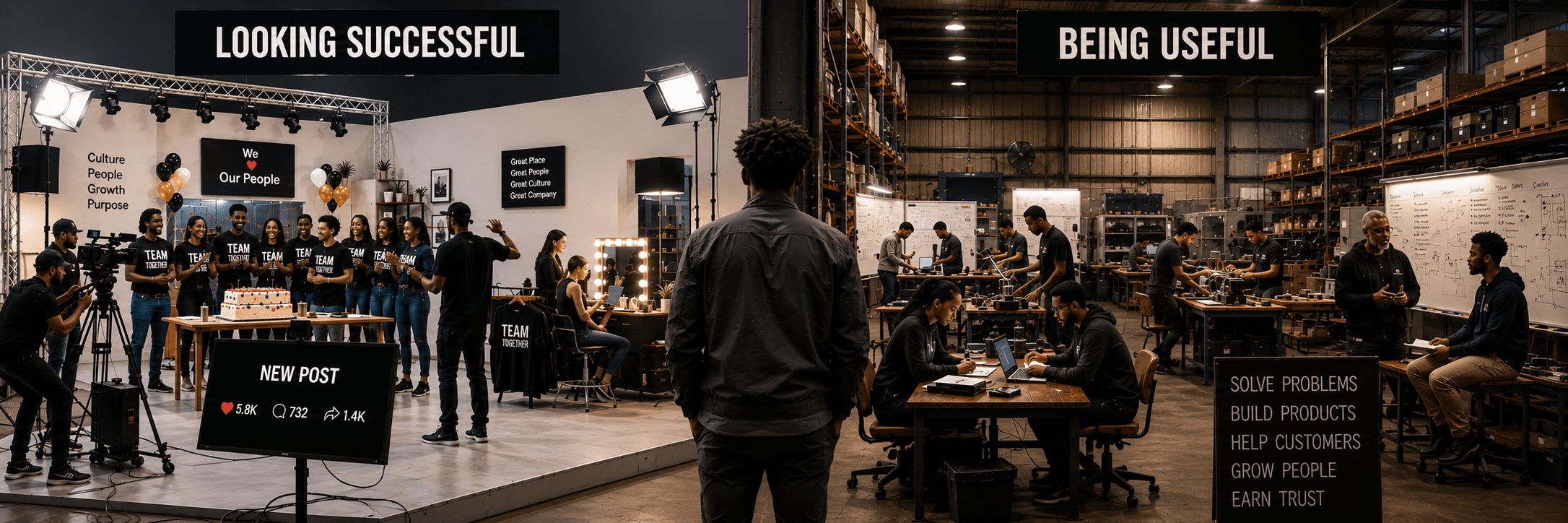
A company celebrates employee birthdays, but not on the actual day. They batch everyone born in March into one event, everyone born in April into another. One cake, one photo, one LinkedIn post.
I don't think they're faking it. Most genuinely want to show their people they matter. But celebrating every birthday on the actual day would be expensive and disruptive, so you batch them, you group the care, and the moment you group the care, something shifts. What started as "we care about you" becomes "we care about caring about you."
That's not malice, it's a system problem — and it's a window into something much bigger happening across corporate social media, where good intentions get swallowed by the machinery of performance.
The Builder's FOMO
Scroll through LinkedIn on any given week and you'll find Father's Day celebration videos, team retreat recaps, group photos with matching t-shirts, announcements about leadership trainings nobody asked about. And if you're a founder who spent that same week debugging a client delivery, negotiating a contract, or sitting across from an underperforming team member having a conversation neither of you wanted to have — you feel a strange guilt. You wonder if you're falling behind because your company isn't producing this content.
You're watching a mirage.
Most of this content serves neither of the two jobs corporate social media is supposed to do. In B2B, your customer is won through a well-prepared sales meeting, a warm introduction from someone who trusts you, a salesperson who shows up and earns credibility over months. Social media on the customer side does one thing: awareness — being the name that comes to mind when someone has a problem you solve. A Father's Day montage doesn't do that. If anything, it raises the question of what you're spending your time on. A company with barely a dozen employees can pour real energy into producing celebration content that gets engagement almost entirely from its own team — the same people who were already in the room. The customer they're trying to reach never saw it. The candidate they're trying to attract scrolled past it.
The usual defence is that this content is for talent, not customers. But LinkedIn's own data shows that candidates start their research on founder and leadership profiles, not the company page. They're looking for credibility signals, values alignment, evidence that the company is what it claims to be. They want to know what problems you're solving and what it's like to work with you when things get hard — not when things are staged for a camera. The best people choose where to work based on the sophistication of the problems, the quality of the people around them, and whether leadership has the clarity to build something real. Nobody worth hiring ever made a career decision because of a birthday reel.
What Care Actually Looks Like
Companies post celebration content because it looks like caring. But the people inside the company already know whether you actually care, and they learned it from moments that will never make it to your LinkedIn feed.
They learned it from how you treated them when they missed a deadline. From what happened when a customer disagreed and you had to choose between protecting your team or protecting the deal. From how you responded when someone made a genuine mistake — not a careless one, but a real one where they were trying and got it wrong. From what you pay them, whether you promote based on performance or politics, whether you respect their time or treat it as a resource you can claim whenever it's convenient.
But care isn't only how you protect people when things go wrong. It's also who they become because they worked with you. The challenge you handed them before they felt ready. The trust you extended before they'd fully earned it. The pressure that stretched them, the learning curve that exhausted them, the standard you refused to lower. Jack Welch, who ran General Electric for two decades and became one of the most studied CEOs of his generation, put it simply: before you are a leader, success is about growing yourself; once you lead, success is about growing others. People can feel the difference between a manager who keeps them comfortable and one who makes them capable — and years later, the second one is the person they credit for who they are. That kind of care doesn't photograph well. It only shows up in the person themselves.
Those are the things that make someone go home and tell a former colleague, "you should come work here." That's what gets talked about at dinners, at gatherings, in the conversations you'll never be in the room for. And that's the most powerful recruiting tool that exists — no LinkedIn post, no hashtag, no employer branding strategy. If I had to pick one metric for whether your employer brand is working, it would be this: are people from your employees' former companies applying to join yours unprompted? If they are, someone talked. And what made them talk wasn't a Father's Day video. It was who they became while working with you, and how you treated them when it was hard.
Why It Persists
Writing about a hard lesson you learned building your company requires vulnerability and the risk of being wrong in public. Posting a team photo with a caption about "our amazing culture" takes five minutes and feels productive. It creates a small dopamine hit — the team feels seen, the likes come in, the page looks alive. But the real function is filling a void. Most companies haven't done the thinking about what their social media is actually supposed to accomplish, and celebration content is what you post when you don't know what to post. Everyone else is doing it, so there's safety in conformity.
What to Do Instead
Write about the problems you're solving and why they're hard. Share how you think, not how you celebrate. Let your people be visible on their own terms, not because a content calendar told them to, but because they're genuinely excited about what they're building. You can't manufacture that with a photo op. You earn it by building something worth talking about.
And if you celebrate something internally, keep it internal. Your people are in the house. They know whether it was real.
If it's real, it doesn't need an audience. If it needs an audience, it probably isn't real.