


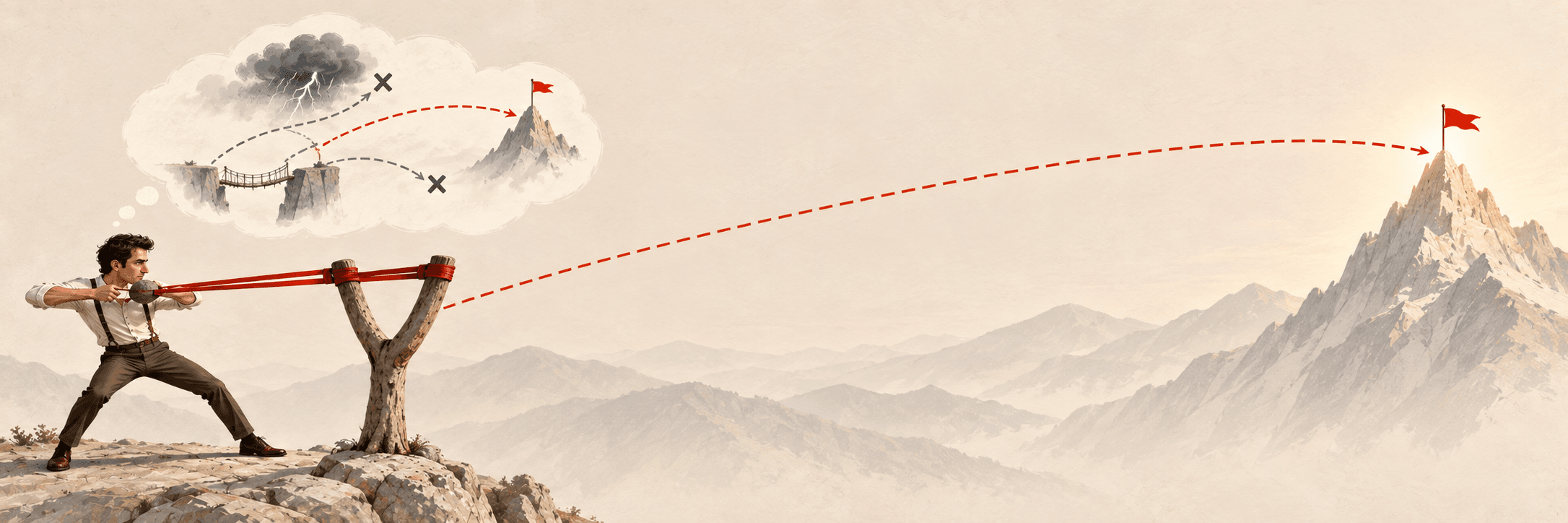
I have been reading The Mind of Napoleon, J. Christopher Herold's collection of Napoleon's own words. One passage got me thinking deep:
"There is no man more pusillanimous than I when I am planning a campaign. I purposely exaggerate all the dangers and all the calamities that the circumstances make possible. I am in a thoroughly painful state of agitation... Once I have made up my mind, everything is forgotten except what leads to success."
It made me look hard at how I run my projects and my businesses.
The man who took most of Europe had more fear than his generals, and he spent it early. He gave doubt a full hearing while the plan could still change, then closed the hearing. Everything after the decision belonged to execution.
Most of us run the opposite schedule. We decide quickly and doubt slowly, and the doubt follows us into the work.
The sentence that kills projects
Listen to how people start things. "Let's give it a shot." "Let's see if it works." The phrase passes for humility and works as a hedge. It lets you start without deciding, so if the thing fails, it never counted against you. It protects your image at the cost of the project.
Half-commitment changes behavior. You hold back the hire and keep the sales call soft, then read the weak results as a verdict on the idea. The project dies of a wound you gave it on day one, and you record it as a failed experiment.
I found this in my own work. Several of my projects had been started but neither killed nor pushed. Limbo feels safe and costs more than failure, because it consumes attention and returns nothing you can decide on.
Two minds, two jobs
Psychologists have a name for Napoleon's rule, borrowed from Caesar. In 1987 Heinz Heckhausen and Peter Gollwitzer described the Rubicon model of action. Before crossing, you deliberate over whether a goal is worth pursuing. After crossing, you work out how to get it done.
Each side of the river runs a different mind. In a 1989 experiment, Gollwitzer and Ronald Kinney had people try to control a light that in fact came on at random. People who had just deliberated an unresolved personal decision judged their control far more accurately than people who had just planned how to execute a goal. Later work by Shelley Taylor and Gollwitzer found the implementing mind rates its own abilities more optimistically. Deliberating makes people accurate; implementing makes them confident beyond the facts.
Each mind is useful in its own phase and harmful in the other. You want the deliberating mind when you choose, because it sees the odds. You want the implementing mind when you build, because a slightly inflated belief in your own control is what carries people through the months when nothing works yet.
Half-heartedness is the two minds mixed. "Let's give it a shot" carries deliberation's doubt into execution, where it slows every action. The reverse mix produces larger disasters: people commit first, then plan with execution's optimism, and every risk looks manageable. Napoleon kept the two apart.
What the team hears
In the middle of describing his agitation, Napoleon adds that it "does not keep me from looking quite serene in front of my entourage." The doubt was real, and it stayed private.
A team takes its level of commitment from the person who started the thing. When a founder says "let's give it a shot," the team hears permission to half-try, and half-tries. Hesitation at the top becomes the effort level of the whole company. Napoleon's marshals executed orders written by a man who had already finished doubting.
Thirty-six days in Moscow
Napoleon broke his own rule once, in 1812.
His army entered Moscow on September 14. The Russians had evacuated the city and set it on fire. In his earlier wars, taking a capital had brought the enemy to the table, so he waited for the Tsar to ask for peace. On September 24 he sent confidential offers. Alexander never answered.
Napoleon did not commit to wintering in Moscow, and he did not leave. By October 5 he was preparing to depart and had ordered the wounded evacuated. He stayed two more weeks. The army marched out on October 19, about 110,000 strong. By Vyazma on November 12 it was down to 55,000, and the retreat became one of the worst in military history.
Historians argue over how much those weeks cost him. He spent them neither deliberating nor executing, waiting in a burned city to see if things would work out, and winter made the decision for him.
In a founder's life, the same limbo is a project that has been "in progress" for fourteen months.
What a test is for
The data on experimenting cuts against the all-in romance.
In 2014, Joseph Raffiee and Jie Feng studied more than 5,000 entrepreneurs. Those who started a business while keeping their day job were 33 percent less likely to fail than those who quit and went all in. The founders who survived best kept the job first, then quit and went full-time; they outlasted people who jumped straight from a job into full-time self-employment by a wide margin. Their hybrid period was deliberation with real data, and it ended in a crossing.
A test belongs to the planning phase. It answers a question set in advance, it has an end date, and it ends in a decision. "Let's give it a shot" asks no specific question and has no end date, so it never forces a crossing. That is how a test becomes limbo.
When people are finally pushed across, they are usually glad. Steven Levitt had more than 20,000 people who were stuck on a hard decision, such as quitting a job or ending a relationship, flip a coin to help them choose. Those the coin told to make the change were more likely to make it and were happier six months later. His conclusion was that people are too cautious with life-changing choices. We overrate the danger of crossing and underrate the cost of standing at the river.
When commitment is stubbornness
There is a failure on the other side too. For every founder who committed and won, others committed with the same ferocity and disappeared. We study the ones who came back. Total commitment guarantees nothing.
Napoleon's rule carries a condition: planning earns commitment. His confidence in execution was borrowed against fear he had already spent, every danger exaggerated and every calamity weighed. Confidence without that prior work is optimism in the wrong phase.
The rule also has an exit. If something fundamental changes, you recross the river on purpose, back into deliberation, and decide again. What you refuse is the slow drift, doubt leaking into the work a little each day.
Which side of the river
Every project you run sits on one bank or the other, or it is standing in the water.
On the near bank, doubt is the work. Find every way the thing can fail, and set the date the doubting ends. A test lives here too, with one question and one deadline. On the far bank, whether is closed and only how remains, and the team should see nothing else on your face. Anything standing in the water is in limbo, and it goes to one bank or the other.
Be as afraid as you like, as long as you are afraid early. Then cross.