

Ego Isn't the Enemy
The difference between believing you can win and being too proud to ask.

Tigabu HaileSeptember 24, 2026
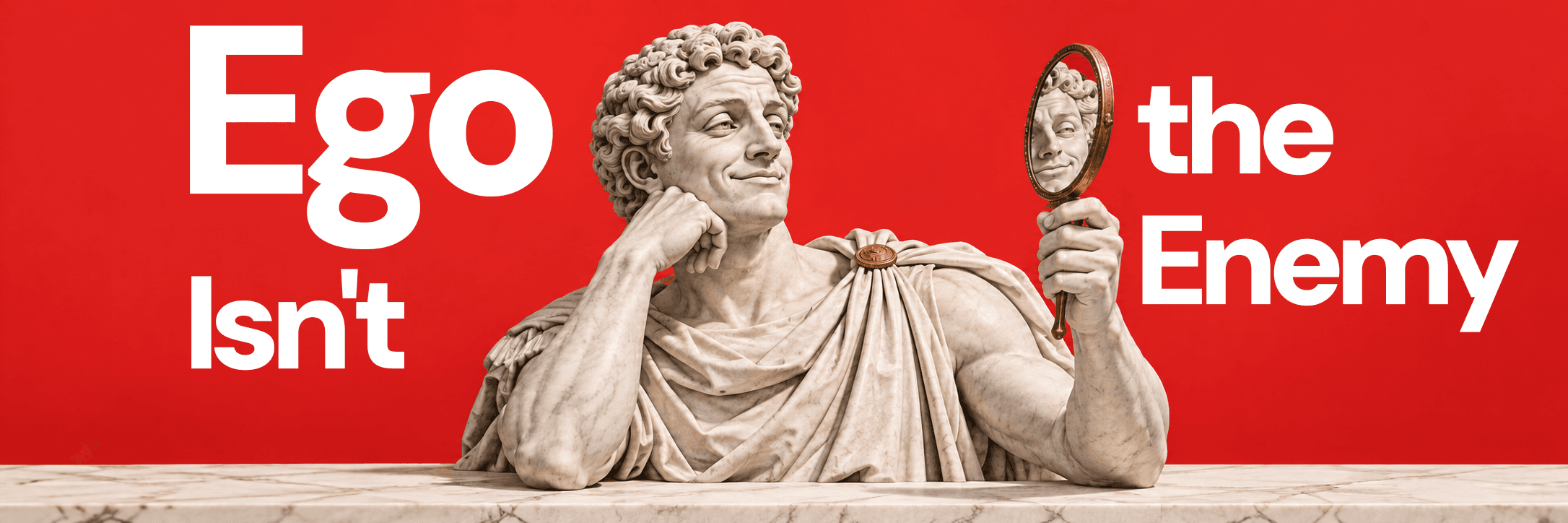
I picked up Ryan Holiday's Ego Is the Enemy because its title made a claim I wasn't sure I believed. Most people accept it without a second thought. Calling someone egoistic is an insult almost everywhere. Say you intend to be the best in your field and someone will tell you to stay humble and let your work speak.
Holiday defines ego as "a kind of unhealthy belief in our own importance". Under that definition his title holds. It is one definition of a much larger word, though, and the narrow version has become the only one people hear. The result is a culture that teaches ambitious people to be ashamed of the thing that drives them.
We use one word for two different things. One makes you believe you can do what nobody around you has done. The other makes you too proud to do what that requires. This essay is a defense of the first and a case against the second.
A word that meant "I"
Ego is Latin for "I." Freud's das Ich became ego in English, the part of the mind that deals with reality. The insult arrived later through a related word: Merriam-Webster traces "egotism" to Joseph Addison in 1714, describing French scholars at Port-Royal who removed the first person from their writing as a sign of vanity.
Dictionaries still carry both meanings. Merriam-Webster lists ego as a justified sense of one's worth, with the example of someone whose ego keeps them from giving up in a competition, and separately as vanity. Holiday wrote about the second meaning, and popular culture kept only that one. The first meaning, the one ambitious people run on, lost its name.
The ego that builds
Picture someone who wants to lead a country of a hundred million people. This person has concluded that of all of them, they should be the one. Whatever you think of politicians, that conclusion requires a scale of self-belief most people never attempt. The runner who intends to be the fastest in the world needs the same thing, and so does the founder who intends to own a market.
Muhammad Ali said "I am the greatest, I said that even before I knew I was." Then he did the part people forget. He admitted he hated every minute of training and refused to quit. His belief came before the evidence, and the work produced the evidence.
That is the only condition I would attach to this kind of ego. It has to be tied to effort and stay open to correction. Believing you can earn the top position is ambition. Believing you are owed it regardless of the work is entitlement, and entitlement is the ego Holiday was warning about.
Past that condition, I see no reason to ask anyone to shrink. Warnings about believing too much are everywhere. The cost of believing too little gets no warning at all, though it is paid by everyone who never learns what they could have done because they were taught early that wanting to be the best was something to hide. Every company, cure and record began with one person deciding they were the one to do it. Tell that person to tone it down and you lose whatever they would have built.
The ego that hides
There is an ego worth fighting, and it looks nothing like arrogance. It keeps you from calling the person who could change your trajectory. It leaves the message unsent and the introduction unmade. After a mistake that hurt your team, it keeps you from saying "I was wrong" to the teammate you need.
The ambitious ego pushes you toward exposure. This one pulls you away from it, and it consistently misjudges the risk. In research by Francis Flynn and Vanessa Bohns, people underestimated by as much as 50% how likely others were to agree to a direct request for help. In one study, participants expected to approach about seven strangers to get a single yes. They needed about two. The researchers traced the gap to what askers pay attention to: they weigh the cost of the favor and overlook how uncomfortable it is for the other person to say no.
Apology follows the same pattern. Psychologists at the University of Mannheim found that people judge their own admission of a mistake more harshly than they judge the same admission from someone else, so the courage you are afraid to show is what the other person is most likely to see.
Why the same person carries both
Both egos often live in one person. Someone can believe they will build the most important company in their industry and still be unable to message one investor who might say no.
The psychologist Michael Kernis offered an explanation by separating secure high self-esteem from fragile high self-esteem. People whose self-worth was stable and not contingent on outcomes were especially low in defensiveness. Those whose high self-worth was unstable or contingent were far more defensive. Secure self-worth can acknowledge weakness without feeling threatened. Fragile self-worth needs constant validation and depends partly on self-deception.
The big ambition is safe because nobody can test it today. The message is a test today. A secure ego sends it because a refusal leaves it intact. A fragile ego avoids it because a refusal would break something. The person who can't apologize has a sense of self that can't survive being wrong.
Lincoln and Stanton
In 1855 Abraham Lincoln joined the defense team in a major patent case. When the trial moved to Cincinnati, Edwin Stanton and another lawyer on the team shut him out of it. Lincoln's response was to study what he had been excluded from. He said he was going home to study law, because men trained like Stanton would soon be practicing in Illinois and he intended to be ready. In January 1862, as president in the middle of a war, he appointed Stanton Secretary of War.
A fragile ego would have spent those years nursing the insult. Lincoln treated it as information about what he still had to learn, then gave the job to the most capable man he knew, the one who had humiliated him. He had enough ego to want the presidency and too little fragility to let an old wound make his decisions.
Why the wrong ego gets the blame
Arrogance is easy to see. It talks over people, takes credit and makes noise. So advice about ego aims at what it can see, and ambitious people learn to keep quiet about how much they want.
The fragile ego leaves no evidence. Nobody sees the call you didn't make or the apology you didn't give. Nobody records the partnership that never started because one person was too proud to ask. Its costs are real and invisible, so they never get counted against it. We end up disciplining the ego that produces results and excusing the one that quietly prevents them.
It should run the other way. Want to be the best in the world, and believe it before anyone else does. Then guard that belief against the pride that won't ask and won't apologize, because that pride has stopped more ambitious people than arrogance ever has.
Keep your ego large. Don't let it get fragile.