


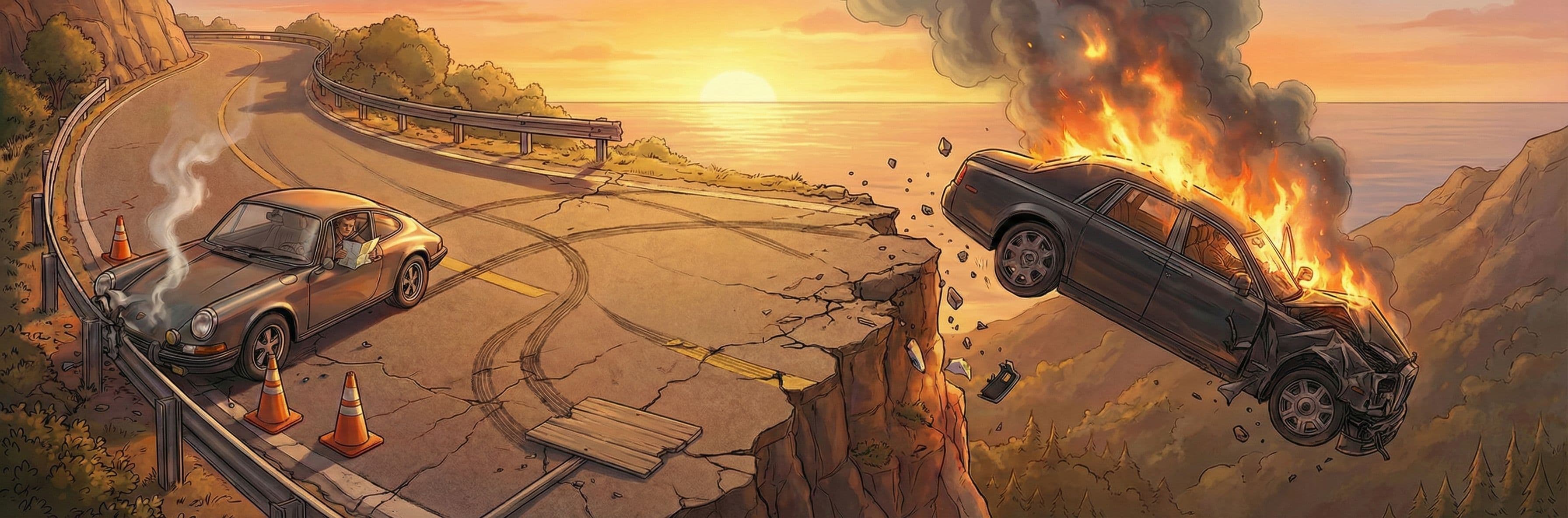
Mistakes should be tolerated. In many forms of meaningful work, business, science, writing, engineering, sport, progress is inseparable from error. If you study any accomplished founder, artist, or athlete closely, you’ll find that the visible successes are a small fraction of the attempts. Most of the work lives in discarded drafts, failed experiments, wrong hires, and decisions that didn’t land. This is not a flaw in the system. It is the system.
The danger begins when that truth is applied indiscriminately. When the same sentence, “I always do it right, this time it happened,” is used to explain a reversible mistake and a catastrophic one. Those two do not belong in the same category. Treating them as equal is how organizations quietly put themselves at risk while believing they are being progressive.
The founder’s responsibility is not to eliminate mistakes. It is to distinguish between mistakes that teach and mistakes that end things.
The Two Kinds of Failure That Get Confused
Some mistakes are tuition. You launch a feature that doesn’t work. You test a channel that fails. You hire someone who looked strong on paper but doesn’t fit the role. You lose time, money, or momentum, but you gain information. The organization becomes sharper because of it.
Other mistakes are cliff mistakes. They don’t care about your history. You can do everything right for years, and one decision made under the wrong conditions can still destroy a company or permanently damage a person. The driving metaphor captures this perfectly. You can drive responsibly for twenty years, but one reckless moment at high speed can still end a life. Past discipline does not neutralize present risk.
This is where many teams get confused. They celebrate failure without asking what kind of failure they are celebrating.
When “Failure Is Good” Stops Being True
Learning cultures are built on safety, but safety is not the absence of consequence. It is the presence of clarity. Teams need to feel safe to surface problems early, admit errors, and question decisions. Without that, learning collapses. But when safety becomes permission to repeat preventable, high-impact mistakes, the system is no longer learning. It is drifting.
The most dangerous environments are not the strict ones. They are the polite ones, where reality gets softened as it travels upward. No one lies. Everyone adapts. Information is filtered just enough to feel acceptable. By the time a serious issue reaches leadership, it is already expensive.
Forgiveness without discrimination does not create innovation. It creates confusion.
A Practical Way to Decide What Gets Tolerated
Before reacting emotionally to a mistake, there are a few questions that cut through noise:
- Is it reversible, or is the damage permanent?
- How wide is the blast radius, one task, one customer, or the whole company?
- How quickly would we detect it if it happened again?
- Is this a rare incident or a repeated pattern?
- Was it human error, risk blindness, or disregard?
These questions matter because each answer demands a different response. Human error calls for better systems. Risk blindness calls for training and guardrails. Disregard calls for accountability. Treating all three the same is how standards decay.
Why High-Performing Organizations Feel “Paranoid”
The best organizations don’t fear mistakes. They fear the wrong kind of mistakes. They pay attention to small signals. They build layers of protection. They assume that failure is rarely one dramatic event and more often a series of small holes lining up across people, process, and timing.
This is why strong companies often appear cautious from the outside. They move deliberately not because they lack courage, but because they understand consequences. They do not rely on individual brilliance or good intentions. They design environments where errors are caught early and reckless behavior has nowhere to hide.
“I’m usually careful” is not a system. Structure is.
What a Healthy Culture Actually Looks Like
A functional culture holds two ideas at the same time.
People can speak early, admit mistakes, and experiment without fear.
Preventable, high-consequence behavior is not normalized or excused.
In that environment, learning accelerates because problems surface before they compound. Standards remain high because forgiveness is paired with judgment. People are not punished for trying. They are held accountable for ignoring risk.
The most productive question a leader can ask after something breaks is simple and uncomfortable:
Was this an experiment that taught us something, or was this avoidable risk dressed up as a mistake?
That question alone reshapes how people think.
The Founder’s Real Job
A founder does not build a company by being harsh or lenient. They build it by being precise. Precision in deciding what is acceptable to learn from and what is unacceptable to gamble with. Precision in responding to error without ego or softness. Precision in protecting the organization while allowing it to grow.
Mistakes are necessary. Failure is unavoidable. But not all mistakes deserve the same response.
Knowing the difference is not just leadership. It is survival.