


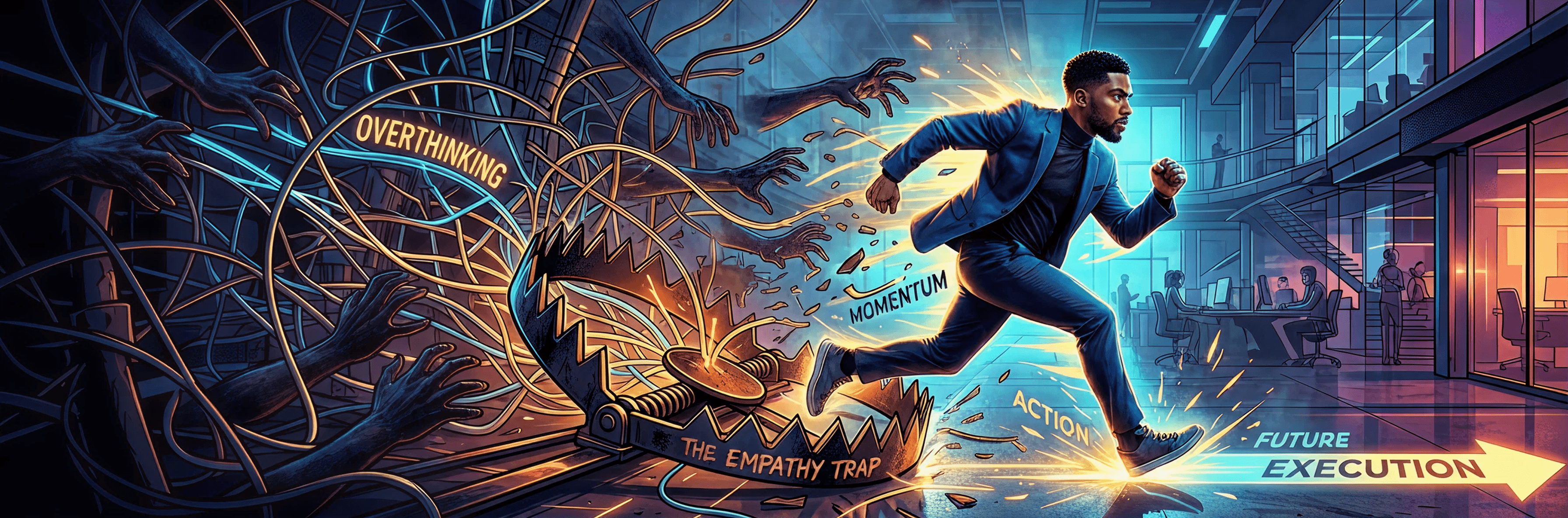
There is a hidden killer of startup velocity that rarely gets mentioned in board meetings or pitch decks. It isn’t flawed code, and it isn’t a bad market. It is the exhausting habit of over-analyzing every conversation, subsidizing those who only take, and burning your cognitive runway trying to keep everyone happy.
If you identify as a "recovering people-pleaser," you likely work brutal hours just to compensate for the energy you leak managing other people’s feelings. You try to mathematically balance relationships and business dynamics that are fundamentally unbalanced. By doing this, you aren't just making yourself tired, you are placing a hard ceiling on your company’s success.
Recently, Marc Andreessen made a claim that ruffled feathers: great people have less introspection. At first glance, this sounds like a free pass to operate with arrogance. But when you look closely at behavioral science and the daily habits of the world's most effective founders, a different reality emerges. The constant overthinking you believe makes you a "highly empathetic leader" is often just a sophisticated shield designed to protect your own ego from the discomfort of conflict. To build a truly exceptional team, that habit has to die.
The Science: You Aren't Learning, You Are Just Dwelling
Organizational psychologist Dr. Tasha Eurich spent years studying self-awareness in the workplace. Her data revealed a fascinating paradox: the people who spend the most time looking inward and overthinking are often the least self-aware and the most stressed.
This happens because the human brain struggles to differentiate between learning and dwelling.
- Dwelling (The Trap): This is the habit of asking Why? (Why did they react that way? Why wasn't my effort appreciated? Why am I always giving more?). This line of questioning puts you inherently on defense. It leads to self-doubt, anchors you in the past, and reinforces the people-pleasing loop.
- Learning (The Weapon): This relies on asking What? (What are the metrics telling us? What is the next logical step? What must we change right now to win?). This shifts you to offense and immediately generates forward motion.
Great founders do not waste mental energy on the "Why" of office politics. They ask "What," execute the next step, and move forward.
Action Over Feelings
When Andreessen points out that elite founders don't over-analyze, he is highlighting a fundamental difference in operating systems. While many get stuck navigating past conversations and social friction, top-tier operators process that friction instantly and convert it into momentum. Building a company from nothing requires you to be slightly unreasonable, you have to see a future no one else sees and pull your team toward it.
Jeff Bezos built Amazon on the principle of "Disagree and Commit" because he understood that stressing over bruised egos after a decision destroys organizational speed. Similarly, Reed Hastings forged Netflix’s legendary culture using the "Keeper Test," where managers regularly ask if they would fight to keep an employee who wanted to leave.
You simply cannot execute a Keeper Test, or demand excellence, if you are paralyzed by the need to be liked. A-players do not want a boss who is a people-pleaser. They want clear objectives, honest feedback, and a leader who is obsessively driven by the mission.
The Reality Check: Bracing for the Pushback
Transitioning from a people-pleaser to a mission-driven founder is going to feel deeply uncomfortable at first.
When you stop giving away your energy for free, the system will push back. The partners, employees, and friends who implicitly relied on your people-pleasing will claim you have changed or call you difficult. You will feel a profound sense of guilt, and your brain will scream at you to revert to your old ways.
Do not fall for the trap. You are not becoming a bad person; you are simply demanding a fair market trade for your time and cognitive energy. Instead of allowing relationships to drain you, you are recalibrating them to serve the mission.
The Framework: The 60-Second Rule
You don’t need to completely turn off your self-awareness; you just need to aim it at the correct target. The next time you catch yourself spinning out over a social interaction, deploy the 60-Second Rule:
- The Trigger: You catch yourself replaying a meeting in your head, over-analyzing the tone of an email, or feeling guilty for saying "no."
- The Filter: Ask yourself one ruthless question: "Will overthinking this improve our product, increase our revenue, or accelerate our speed?"
- The Drop: If the answer is no, the thought is being driven by your ego, not your business. Give yourself exactly 60 seconds to feel the human emotion—frustration, guilt, annoyance. Once that minute is up, the thought is dead. Move on.
You have likely spent the last decade relying on sheer willpower to carry both your company and the weight of everyone else's feelings. It is time to drop the feelings and plug the energy leaks. When you pour 100% of your massive work ethic directly into the execution of the mission, you won't just build a great company. You will be unstoppable.