


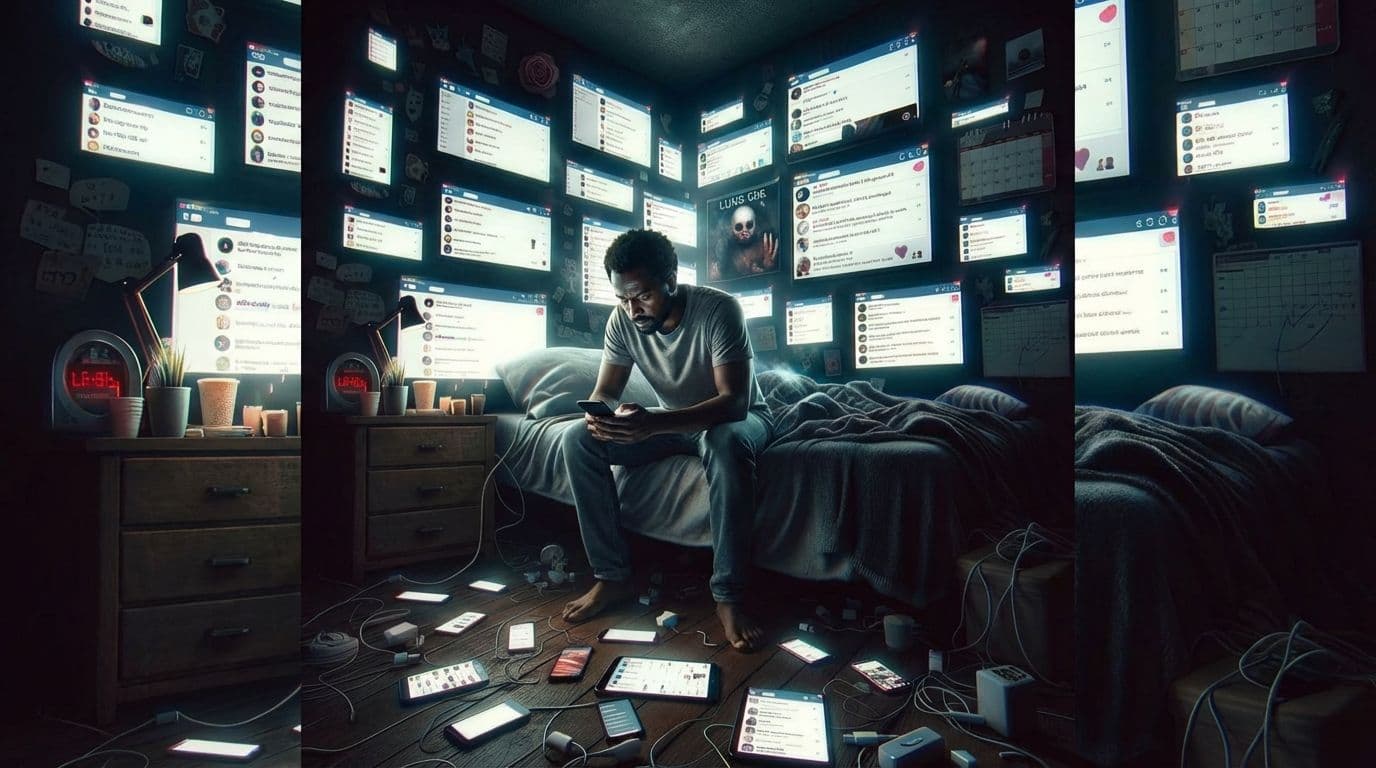
Information feels harmless because it leaves no immediate trace.
A drink has a cost you feel the next morning. Food leaves evidence in your body. Information hides its cost inside attention. You can spend eight hours consuming, go to bed “informed,” and still wake up with nothing built, nothing clarified, nothing changed.
That is the quiet danger of modern consumption. It feels productive without producing anything.
The world is not suffering from a lack of knowledge. It is suffering from unmanaged attention.
Long before social media, Herbert Simon, a Nobel Prize–winning economist and one of the founders of modern decision theory, warned in his 1971 lecture that an abundance of information creates a scarcity elsewhere: attention. When attention fragments, intention collapses. And when intention collapses, action disappears.
The Question Most People Never Ask
Why am I consuming this?
People like to believe they consume intentionally. In practice, most consumption is inherited, not chosen.
Sometimes you are learning. Sometimes you are entertained. Sometimes you are distracted. Sometimes you are anxious and soothing yourself. Sometimes you are collecting information purely so you can talk about it later, at dinner, in a group chat, at work.
None of these are inherently wrong.
The problem begins when everything feels important, urgent, or necessary, even when it has no relevance to your actual life. When every article, video, scandal, and opinion demands attention, the default becomes passive intake. You stop choosing. You start absorbing.
At that point, consumption becomes a background habit, not a conscious act.
Entertainment Is Not the Enemy
Confusion is.
This is not an argument against entertainment.
You can spend eight hours watching something purely for pleasure and still be honest about it. The damage comes from mislabeling. Entertainment disguised as obligation. Distraction disguised as education. Noise disguised as relevance.
Most information today wears a costume of usefulness. It sounds important. It feels informed. But when you step back and ask what it actually changes, the answer is often nothing.
If consuming a piece of information does not alter your actions, your thinking, your decisions, or your relationships, then it did not educate you. It occupied you.
The 30-Day Filter
A test most information fails.
A simple discipline changes everything: What will I do with this information in the next 30 days?
If the honest answer is “nothing,” then call it what it is. Entertainment. Distraction. Social currency. Emotional filler.
Even if you lower the bar and ask a second question, most information still collapses: What belief, attitude, or behavior will change because of this?
If the answer is still “nothing,” then this content is not neutral. It is consuming your time while giving nothing back.
Multiply that by hours per day, days per week, years of life, and the cost becomes obvious.
Why Mindless Consumption Persists
Because it feels easier than action.
The brain is designed to preserve energy and avoid discomfort. Consumption offers novelty without risk, stimulation without responsibility, emotion without consequence.
Creation, reflection, learning deeply, or acting on knowledge all demand friction. They are slower. The reward is delayed. That delay is exactly why they change lives, and exactly why most people avoid them.
This is why billions of people can scroll endlessly yet struggle to read thirty focused minutes a day from a book that could materially change their life. The issue is not intelligence. It is default behavior.
Patterns Older Than Technology
The medium changed, the habit didn’t. This is not a modern problem.
Thousands of years ago, some people gathered to debate ideas, principles, and systems. Others gathered to talk about people. The ratio has always been the same. What changed is scale and design.
Today, information is infinite, frictionless, and algorithmically optimized to hold attention. The town square fits in your pocket and never closes. Without filters, inherited consumption becomes inevitable.
A Practical Categorization That Works
Give your consumption a job title. You don’t need discipline. You need clarity. Every piece of information should fall into one of three buckets:
Entertainment: Chosen deliberately. Time-bound. Enjoyed without guilt.
Education: Only counts if it sharpens judgment, improves skill, or leads to action.
Distraction: Information that feels important but serves no purpose, changes nothing, and quietly erodes focus.
Once you label information honestly, behavior changes automatically. You stop pretending. You stop negotiating. You stop over-consuming without awareness.
The Real Cost
Attention becomes direction, direction becomes identity
What you repeatedly pay attention to shapes what you value. What you value shapes how you act. How you act shapes who you become.
Information is not free. You pay with attention. Attention compounds.
If your days are dominated by information that never turns into action, insight, or creation, then the outcome is predictable: stagnation disguised as awareness.
The Point
Choose your inputs like your life depends on it. Because it does.
A sharper life does not begin with better information. It begins with asking, consistently and honestly:
What is this for?
That single question eliminates most noise. It returns agency. And it forces consumption to justify itself, instead of quietly running your life.